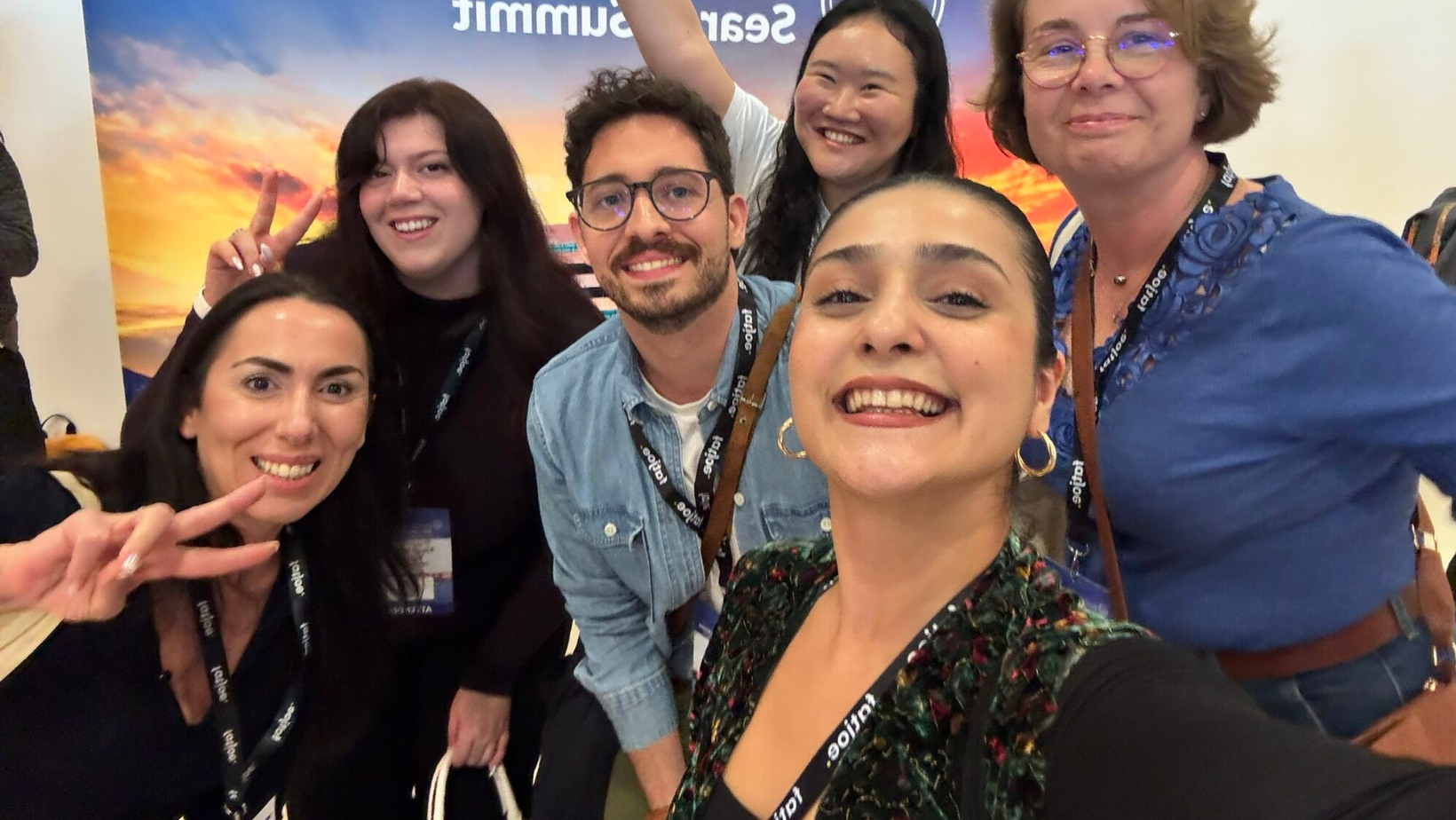
Faezeh Shafiee is an SEO Content Manager specialising in B2B SaaS, eCommerce, and sustainability. With a background in literature, she combines SEO research, storytelling, and editorial judgment to create content designed for long-term impact in an evolving search landscape.
Her first-hand perspective on life in Iran is both important and inspiring, offering a rare view beyond the headlines.
1. Your background in literature clearly shapes your work. How has storytelling influenced the way you approach SEO content?
At a certain point in my literature studies, I was introduced to a demanding writing principle often attributed to Chekhov: every element in a story must serve a purpose. If a detail appears, it needs to matter. Otherwise, it shouldn’t be there.
When I was writing short stories in college, this idea was drilled into us during editing. Every sentence had to earn its place. If a detail didn’t move the story forward, it was cut, no matter how nice it sounded.
I guess that mindset never really left me.
When I work on SEO content, I approach it the same way. Every heading, paragraph, internal or external link, and example has to justify its presence. I’m constantly asking: What role does this play for the reader? Does it move them forward, or slow them down?
This is how storytelling influences my SEO work: in its structure, intention, and understanding exactly why each element exists.
The formats and platforms may change, but the standard I work by stays the same. I aim to create content that is genuinely useful to the reader and intentional from the brand’s side.
If every element has a reason to exist, the content holds up over time. It’s clear, focused, and respectful of attention.
2. Writing “for people but optimising for search” is a recurring theme in your work. Where do you usually draw the line between creativity and optimisation?
For me, that line is set by intent and format; it’s not by a fixed rule.
Some content needs to be straightforward. A how-to article, comparison page, or support-style piece should prioritise clarity and speed. In those cases, optimisation leads the way, and creativity shows up in structure: how clearly the information is ordered and how easy it is to move through.
Other formats allow a wider range. Thought leadership, interviews, or narrative pieces leave room for voice and perspective. Even then, creativity has limits. If it slows the reader down or obscures the reason they came, it stops being useful.
So I don’t see creativity and optimisation as opposing forces. Optimisation defines what must be answered and how it should be surfaced. Creativity shapes the experience of reading it. The balance is right when the content feels natural to the reader and still does its job.
3. What kind of role are you looking for next, and how would you describe your ideal position?
Most of my experience has been in startups and small teams, where I built content systems from scratch, worked under pressure, and owned projects end-to-end. That environment made me very hands-on and adaptable.
At this point in my career, I’m looking to join a more structured team that genuinely values content and gives it the time to be done well. My core focus is still content, research, writing, briefing, and editing, but I’m also deepening my technical SEO skills so I can be involved beyond execution and closer to strategy.
Ideally, I’m looking for a role where content is treated as a long-term investment and where I can grow alongside a team while contributing valuable work from day one.
4. From your perspective, why should a company hire you instead of a more traditional SEO content profile?
I don’t think the difference is traditional versus non-traditional SEO. The real difference is whether someone understands how content fits into a wider system.
A lot of SEO content looks fine on the surface, but it’s disconnected from how people actually search, read, and make decisions. My focus is on understanding intent properly, structuring content so it can perform across different surfaces, and making sure it serves a real purpose, not just ticks a keyword box.
I’m comfortable with the fundamentals, but I’m more interested in how things behave in practice: what gets clicked or nowadays pops up in LLMs, what gets ignored, what holds attention, and what converts.
That means working closely with other teams, being realistic about limitations, and making data-driven decisions based on impact rather than theory.
I can operate within clear processes, but I don’t treat SEO as a static playbook. The work that lasts is the work that’s been thought through properly, and that’s the standard I try to bring to it.
5. Having worked across B2B SaaS, eCommerce, and sustainability, which type of content challenges you the most and why?
Each space has its own challenges, but B2B SaaS has probably been the most demanding in terms of depth. You can’t write well about a product unless you really understand it, so a lot of the work happens before writing: learning the product, talking to customer support, sitting with developers, understanding edge cases, and seeing how users actually interact with it. That learning curve is real, but it’s also what makes the content stronger.
That said, sustainability, especially in a blockchain context, was the most challenging and the most stimulating one for me. It forced me to constantly learn, question claims, interview experts on complex topics like greenwashing or carbon credits, and balance technical accuracy with real human stories.
Both pushed me in different ways, but sustainability stretched me the furthest intellectually, while SaaS demanded the most operational maturity.
6. Which skills will matter most for content marketers as AI-driven search evolves?
I think that would be editorial judgment!
AI can speed up research, drafting, and optimisation, but it can’t decide what actually deserves to exist. Knowing what to say, what not to say, how deep to go, and who you’re really writing for matters more than ever. Without strategy and intent behind it, content just becomes noise, regardless of how optimised it is.
I use AI in my own workflow to explore angles, polish language, or sanity-check structure, but the work that performs comes from the thinking before the draft: research, clear briefs, understanding the audience, and having a point of view. That’s what consistently gets content cited, shared, and trusted.
Search surfaces may change, from traditional SEO to AI overviews to whatever comes next, but people are still the ones reading, clicking, and deciding.
So if you write with real users in mind, structure information clearly, and offer genuine value to your, AI systems tend to follow that signal rather than the other way around.
7. Attending Women in Tech SEO in London will be a first for you. What are you most excited to learn or experience there?
I was really excited to attend WTS London for the first time, but due to visa complications, I had to step back and pass the in-person ticket on to someone who could fully enjoy the experience.
That said, I’m incredibly grateful to be part of such a supportive community. The team kindly changed my ticket to a conference-only option, so I can still learn from the talks, take notes, and make the most of the experience. It’s genuinely heartwarming, and honestly a bit emotional, to feel this level of care and inclusion.
To everyone attending in London, I hope you have a brilliant time, and hopefully next year I’ll be there in person. 🤍
8. Many people only know Iran through headlines. What’s one thing about Iranian culture or daily life that is often misunderstood?
Well, one of the biggest misconceptions is that Iran is defined by its government. It isn’t! Iran is a country of over 90 million people, with deep cultural, ethnic, and linguistic diversity, Fras, Kurds, Turks, Arabs, Baluch, Lors, and others, all living under a dictatorship system that does not represent them.
What the world often sees as “Iran” is the Islamic Republic’s propaganda, not the reality of everyday life. Most people are educated, globally aware, and far more progressive than the laws imposed on them.
Many of us grew up with access to 100% free education, from school through university. And somehow limited and filtered yet still available international sources of information, which is exactly why so many began questioning, resisting, and demanding change.
What people inside Iran want is not extraordinary! Freedom of expression, access to unfiltered information, and the right to live without fear of punishment for how they speak, think, or exist.
The real Iran is made up of people who continue to demand those rights, even when the cost is high. It lives in that insistence on freedom and a dignified life, not in the regime that denies it.
9. How would you describe the marketing and SEO scene in Iran to someone who’s never been exposed to it?
I’d describe the marketing and SEO scene in Iran as talented, yet structurally limited.
There’s a clear gap between how SEO is practiced globally versus in Iran. Internationally, SEO has moved toward strategy, owning growth narratives, aligning with product and content, and influencing business decisions. In Iran, it’s still largely treated as an execution role.
I recently read a report by Mohammadreza Hassanpour, an SEO manager and a former university classmate, and it illustrated this well. In global job listings, strategy is one of the most in-demand SEO skills, while in Iran, it appears in just over 1% of roles. Most positions focus on very specific tasks rather than ownership or long-term impact.
You can see this mindset reflected in how roles are defined. Many job descriptions are tightly coupled with WordPress, which signals a market centered around small businesses and agencies operating within narrow CMS-based ecosystems rather than diverse, product-led, or custom-built environments.
AI adoption follows a similar pattern. While globally SEO teams are experimenting with automation, data workflows, and LLMs to support research, scale, and decision-making, in Iran, AI is often mentioned at a surface level, more as a buzzword than as something embedded into real processes or workflows.
This isn’t about a lack of skill or ambition. It’s mostly driven by market maturity, access limitations, and infrastructure. There’s a lot of potential, but the ecosystem still prioritizes execution over strategic ownership and growth thinking.
10. What do you enjoy most about living in Tarragona?
Tarragona gives me the balance I need. It’s a rare plus to have both the sea and the mountains so close. On hot summer days, I can go for a swim in the sea, and when I want a break from the heat, I head up to La Mussara for cooler air and breathtaking views.
It’s also much less chaotic than Barcelona. Before moving to Spain, I lived in Istanbul, right in one of the most touristic areas on the European side. Coming from that level of intensity and constant movement, I really needed calm, and Tarragona delivered that perfectly. It gives me space to think and recharge, while still feeling connected and inspired.