
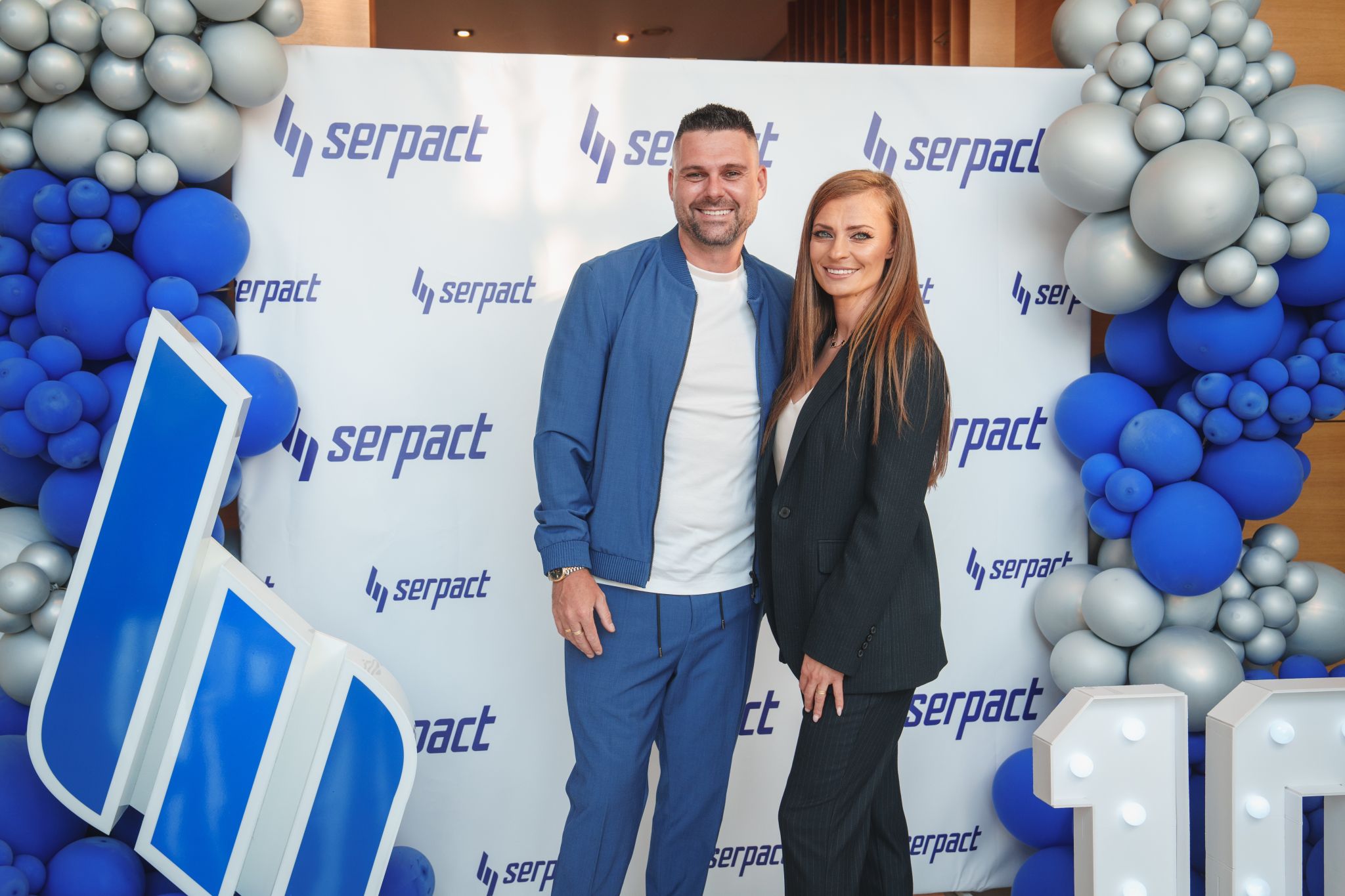
Nikola Minkov is the founder and CEO of Serpact, SERP Conf., and SERP Acad., and one of the leading voices in the European Search industry.
With more than a decade of experience and over 3,000 SEO projects delivered, he has helped put Bulgaria on the global SEO map through conferences, education, software, and community-building initiatives.
1. Building SERP Conf. from Sofia to Vienna and Rome is a bold move. What did expanding internationally teach you about the differences between SEO communities across Europe?
You might be surprised, but in this case, the geography matters less than the mindset. We shouldn’t be talking about SERP Conf. Sofia vs. SERP Conf. Vienna vs. SERP Conf. Rome – the market is one – we are all part ot the European Union. But the differentiation sits in the digital transformation journey of businesses in these countries.
In Bulgaria, the SEO community is hungry for more – more knowledge, more new ideas, more networking. People come to learn what works now because budgets are tighter and mistakes are more expensive. There’s less room for experimentation and almost no one is daring to try – especially when we talk about companies’ money..
In Austria (and the DACH region as a whole), my observations are that the audience is more enterprise-focused. The questions are more sophisticated, but the challenges professionals face there are the same everywhere: visibility, attribution, AI disruption, etc.
As of the Rome edition, 2026, it will be our first, and we’re still learning, but early conversations suggest the market views SEO through the lens of brand perception and offline reputation in more practical, direct ways.
What didn’t change across borders is the need for honest, actionable content. The audience is tired of recycled slides and buzzwords. People want to know what you’re actually doing, what’s working, and what’s failing. That’s universal.
Expanding taught me that SERP Conf. isn’t a Bulgarian event that went international—it’s a format that works because it respects the audience’s time and intelligence, regardless of where they’re sitting.
2. SERP Conf. positions itself as a “see it Monday, try it Tuesday” event. How do you ensure speakers deliver truly actionable content instead of recycled theory?
We reject over 90% of speaker applications, and the direction we are thinking is, “What will someone in the audience start doing differently because of the talk of this proposed speaker?” We require real case studies with data – something like “we did this, here’s what happened, here’s the revenue impact”. As many people may have noticed, we keep a one-stage-only format, and that also forces ruthless curation.
We conduct speaker prep calls to challenge assumptions and ensure content is specific, not generic. One of our main goals is that the audience leave with frameworks, tools, and strategies they can implement immediately. That is our promise, and we protect it ruthlessly.
3. Over 60% of SERP Acad. graduates advance professionally or launch businesses. What skills are proving most transformative for students today?
Ten years ago, knowing some tool was a differentiator, but now tools are commoditized. What separates advancement from stagnation is the ability to ask the right questions. So let’s say: critical thinking. And also understanding of semantic thinking (user intent, entity relationships, how AI systems interpret meaning). All things that tie SEO work to business outcomes like CAC, LTV, and revenue attribution.
AI rewrites the rules every day, and we teach our students to frameworks for learning and adapting quickly as the landscape shifts.
4. As a part of the Bulgarian E-commerce Association (BEA), what structural changes are most needed to strengthen the digital ecosystem in Bulgaria?
During my two mandates as a Board Member of the Bulgarian E-commerce Association (BEA), I saw firsthand that our relatively small market evolves. In 2024, the Bulgarian e-commerce market was in the top 3 in Europe in terms of market growth. Last year, the growth was about 15%, and this year we expect to report an increase of between 14 and 18%.
The market is driven by increasingly demanding consumers seeking convenience and fast delivery, which imposes higher standards for logistics and marketing.
Above all, we need regulatory clarity around AI and data. Bulgarian businesses are cautious about AI adoption partly because the legal framework is unclear. Also, if we want to build globally competitive businesses, we need to share knowledge, not hoard it.
That’s why I’m involved in initiatives like SERP Conf. and SERP Acad. – because a stronger ecosystem benefits everyone.
5. Hosting international speakers like Gary Illyes and Patrick Stox puts SERP Conf. on the global map. What do you think top-tier experts look for before committing to an event?
No matter our status or title, we all, as professionals, are looking mainly for one thing: respect for our time and reputation.
Top-tier speakers get dozens of invitations every month and say yes only to events that won’t waste their time or damage their credibility by association with low-quality content.
Audience quality matters, too. These experts want to speak to people who will engage, ask intelligent questions, and actually implement what they share.
6. After building multiple businesses and initiatives, what has been the toughest leadership lesson you’ve had to learn?
The toughest lesson was learning to let go and accept that good enough executed is better than perfect delayed. Now my role is to set direction, remove obstacles, and step in only when needed.
The businesses you mentioned only work because I have dedicated and inspired teams behind each endeavor. And the results speak for themselves – Serpact, SERP Conf., Trackian, SERP Acad.SERP Flix are now internationally recognized. The same will apply to our newly launched AI Entry and FactMatters, I am sure of it.
7. Moving from leading an agency to building a SaaS product like Trackian, what challenged you the most at a personal and strategic level?
Agencies solve problems for clients; SaaS solves problems at scale. You basically shift from services to products. And come to think of it – the hardest part regarding both levels you mentioned was patience: agencies see results immediately (launch a campaign, see traffic, report to the client), but SaaS is slow – you build, iterate, wait for adoption, gather feedback, rebuild, and the feedback loop is months, not days.
8. Having completed over 3000 SEO projects and now building platforms and communities, how has your definition of “impact” evolved over the years?
Early in my career, impact meant deliverables: no matter if we are talking about audits, rankings, traffic, etc. Now, impact means how many people’s careers or businesses were changed because of something my team and I built.
For example, SERP Acad. graduates who are starting agencies or new businesses. SERP Conf. attendees who are implementing strategies that make them achieve more as professionals. Trackian users who are gaining visibility they didn’t have before. AI Entry subscribers who are optimizing for what weren’t able to measure before. FactMatters adopters, the first contextual fact-checker for professionals, who are verifying every claim to protect their reputation and keep the web clean.
I realized that optimizing a single website helps a single business. But sharing knowledge about SEO helps many more. What I am trying to say is that the impact now isn’t about what I personally accomplish. It’s about what becomes possible because of the systems, knowledge, and connections I help create.
9. Academia, entrepreneurship, community building… how do you personally manage focus and avoid burnout?
I don’t manage it perfectly, but I’ve learned a few things.
I can’t do everything, so I focus on what only I can do, say no to almost everything (most opportunities are distractions disguised as good ideas), and use time blocking so certain days are for agency work, others for product development, others for SERP Conf. planning, etc. Because mixing them creates chaos. Also, I structure my week so high-energy work (speaking, strategizing) balances low-energy work (admin, reviews), because some tasks drain me and others energize me.
I used to be always-on, but now I protect weekends and evenings with my family and friends more carefully. Do I still burn out sometimes? Yes. But I recover faster because I’ve learned to recognize the signs earlier.
10. Outside of SEO and business, what keeps you grounded and inspired?
My life and work partner, Katya Minkova (Deputy CEO of Serpact), keeps me both grounded and inspired.
She’s the balance I need – when I’m too deep in strategy or vision, she brings me back to reality, and when I doubt, she reminds me why we started. My family and friends keep me grounded by reminding me there’s a world outside SEO and business. And my coworkers inspire me with their enthusiasm and professionalism: watching them grow, solve problems, push boundaries, etc. This is one of the most rewarding parts of what I do. There’s a quote I return to often: ‘Individually, we are one drop. Together, we are an ocean.’
It captures everything I believe about leadership, community, and impact. None of what I have would exist without the people around me, and that’s what keeps me inspired every day.