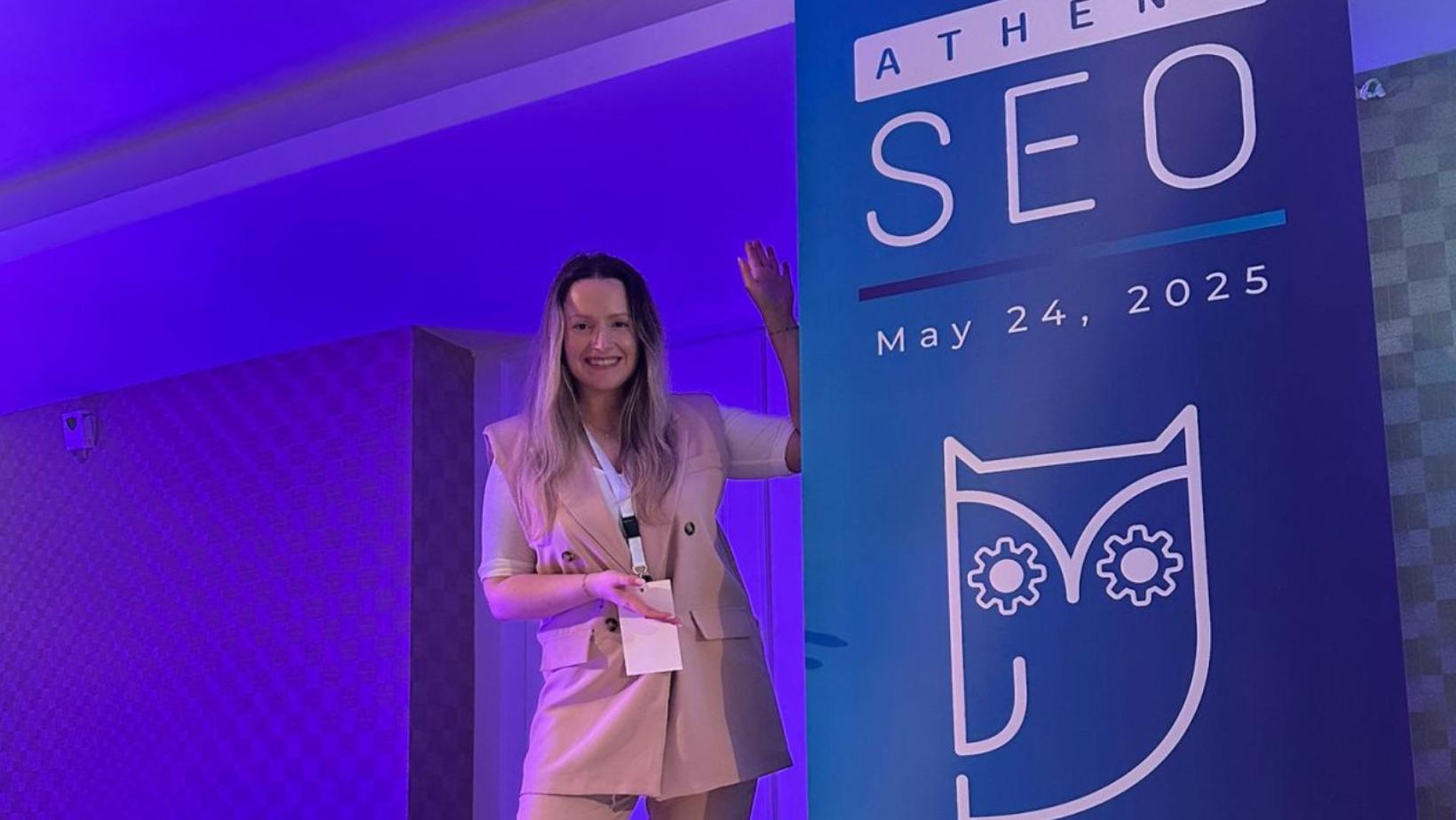
Eva Mermingi is a Technical SEO Consultant and Co-Founder of Athens SEO, Greece’s first international SEO conference. Known for her technical precision, AI experiments and human-first approach to search, Eva is quickly becoming one of the most recognisable voices in the international SEO community.
Also, one of my favorite people in Search: smart, funny, adorable and somehow always with the perfect meme at the perfect moment. It’s an honour to call you my friend!
1. Athens SEO talks a lot about community and zero gatekeeping. How do you intentionally protect that energy as the event grows?
For me, zero gatekeeping isn’t a marketing line – it’s how I believe this industry should work. Knowledge shouldn’t sit behind paywalls or VIP lists. When I started Athens SEO, the whole point was to create a space where a junior SEO sitting next to someone with 15 years of experience could have the same conversation, ask the same questions, and feel equally welcome.
That’s not something you protect with rules – you protect it by being intentional about the culture from day one. Who you invite to speak, how you price tickets, how you treat people. If the energy is right and genuine, people feel it immediately. And people who feel it? Form a community that grows together.
2. For the second edition, where do you see the biggest evolution in the programme?
Depth. Last year was about proving that Athens could host a world-class technical SEO event. This year the programme reflects where the industry actually is – AI’s real impact on search, the intersection of development and SEO, vector embeddings, multi-platform search ecosystems.
What I’m personally most excited about though is the calibre of people in the room. When you put this lineup in the same space as people who flew in from across Europe specifically to learn – the conversations that happen between sessions become just as valuable as what happens on stage. You can’t plan that. You just create the conditions for it!
3. For someone visiting Athens for the first time, what places are a must-see?
Oh, where do I start! Athens is one of those cities that surprises people. Everyone expects the Acropolis – and yes, go, obviously – but what I love showing people is the neighbourhood side. Plaka early in the morning before the tourists wake up. Anafiotika, which feels like you accidentally walked onto a Cycladic island in the middle of the city. Exarcheia for the street art and the raw energy. And please eat everything. Go to a taverna in Psyri, try the local wines, and don’t skip the street food – a good souvlaki from the right place is a spiritual experience!
For islands, if you have 2-3 days after the conference, Hydra is magical – no cars, no motorbikes, just donkeys and the sea. It’s close enough to Athens that you don’t waste a day travelling. Aegina is even closer and completely underrated. Save Santorini for another trip; the nearby islands have all the magic without the crowds. And if you need help planning, reach out to us – we’re happy to help with recommendations!
4. What does strategic thinking actually look like when working with a client?
It starts with understanding what the site is actually for – not only what the client tells me it’s for, but what the data says. A lot of technical SEO work fails because people jump straight into fixing crawl errors and optimising meta tags without asking the fundamental question: what is this site trying to achieve, and is the technical infrastructure supporting that goal?
In practice, I spend more time in Search Console at the beginning of an engagement than most people expect. I want to understand how Google sees the site before I tell the client how I see it. Once I understand that, every technical recommendation has a business reason behind it. I don’t fix things because they’re broken; I fix things because fixing them moves something the client actually cares about.
5. When indexation issues appear, how do you prioritise which signals to investigate first?
I always start with the question Google is implicitly answering: ‘Why would I NOT index this?’ Because Google’s default is to index. If something isn’t indexed, there’s a reason – and it’s usually one of three things: Google can’t access it, Google doesn’t think it’s valuable enough, or Google thinks something else already covers it.
I had a case recently where over a hundred indexable pages were being rejected by Google. Everything looked fine technically – the pages returned 200, had internal links, were in the sitemap. But when I looked at the crawl data, Google had visited these pages months ago and simply hadn’t come back. The root cause wasn’t the pages – it was a migration that broke Google’s trust in the domain. Completely different fix than what the surface suggested.
Follow the hierarchy – access, quality, canonicalisation – and the root cause usually reveals itself before you’ve opened your third report.
6. What technical SEO problem do you think the industry oversimplifies?
Site migrations. By a mile. Migrations are not a simple checklist – redirect mapping, canonical updates, submit to Search Console, done. A migration is the single highest-risk thing you can do to a site. It’s not a technical task, it’s a strategic one. You’re asking Google to re-evaluate everything it knows about your site simultaneously.
What gets oversimplified is the human layer. The developers who implement redirects don’t always understand why redirect chains matter. The stakeholders who approve the timeline don’t understand that rushing a migration creates technical debt that takes months to untangle. And the SEO who’s managing it needs to speak both languages – technical enough to audit the implementation, strategic enough to push back when the timeline doesn’t allow for proper QA.
In migrations, we can easily go from “it depends” to “winter is coming”!
7. In cases where Google overrides canonicals, how do you approach diagnosing the root cause?
When Google overrides your declared canonical, it’s telling you ‘I found a version I think is better.’ The question is why.
I compare the two URLs, look at what’s pointing at each version – internal links, sitemaps – and follow the signals. If your sitemap declares one URL but most of your internal links point to another, Google will follow the strongest signal, not the tag.
I had a case where a trailing slash inconsistency – literally one character – was causing Google to choose its own canonical across multiple pages. Simple fix once you find it, but the tools only told me Google disagreed. They didn’t tell me why. Tools tell you what Google chose. The why lives in the architecture.
8. Which AI tools have genuinely changed how you work?
Honestly? Claude and Gemini, but not in the way most people expect. I don’t primarily use them for automation. I use them to learn. To brainstorm. To challenge my own thinking.
When I’m exploring a new concept or want to pressure-test an approach before recommending it to a client, I’ll run it through AI first — not to get the answer, but to get a better question. It’s like having a sparring partner available at midnight when your brain is still buzzing with ideas. ‘What am I missing here? What’s the counter-argument? What would happen if I approached this differently?’
I also use AI for content creation on my animal welfare educational website — articles about stray animals to raise awareness, guides for pet owners. But even there, I make sure every piece of information comes from reliable sources. Every article includes references with links to veterinary studies, animal welfare organisations, credible publications. AI helps me produce the content faster, but the accuracy and sourcing is always on me.
That’s the thread through everything — AI has genuinely made me better and faster at what I do. But it doesn’t give you judgment. I always filter everything through my own critical thinking. The moment you stop questioning what AI tells you is the moment you stop being the expert and start being the operator. I have no interest in being the operator.
9. Do you think most businesses would benefit more from fixing fundamentals than chasing AI trends?
Absolutely. And I say this as someone who actively uses AI in my work. Most sites I audit don’t have an AI problem – they have a crawlability problem, an indexation problem, a site structure problem. They want to talk about ChatGPT search while they have duplication issues and not enough content on their important pages.
I recently worked on a site where the documentation platform was leaking over a hundred system files into Google’s crawl – junk URLs that Google kept trying to process and couldn’t. Nearly half of all their ‘not indexed’ pages were platform noise. The fix was one line in robots.txt. That’s not an AI problem. That’s a fundamentals problem disguised as an indexation crisis.
These are the things that determine whether Google can even understand your site. Fix the foundation first. Then build.
10. What skills do you think will matter more than tools in the next five years?
Critical thinking. Tools will get better, faster, cheaper. AI will automate more of the execution. But the ability to look at data and say ‘wait, this isn’t a content problem, this is a trust problem’ – that comes from experience, not a crawl report.
And communication. The best technical SEOs I know aren’t necessarily the most technically skilled – they’re the ones who can bridge the gap. If you can’t translate ‘your canonical tags are being overridden’ into ‘this is why your German pages aren’t showing up in German search results and it’s costing you this much traffic,’ the technical knowledge doesn’t land. The client nods politely and nothing changes.
The SEOs who thrive will be the ones who can think, communicate, and make decisions under uncertainty. The tools will handle the rest. And honestly? That excites me!