
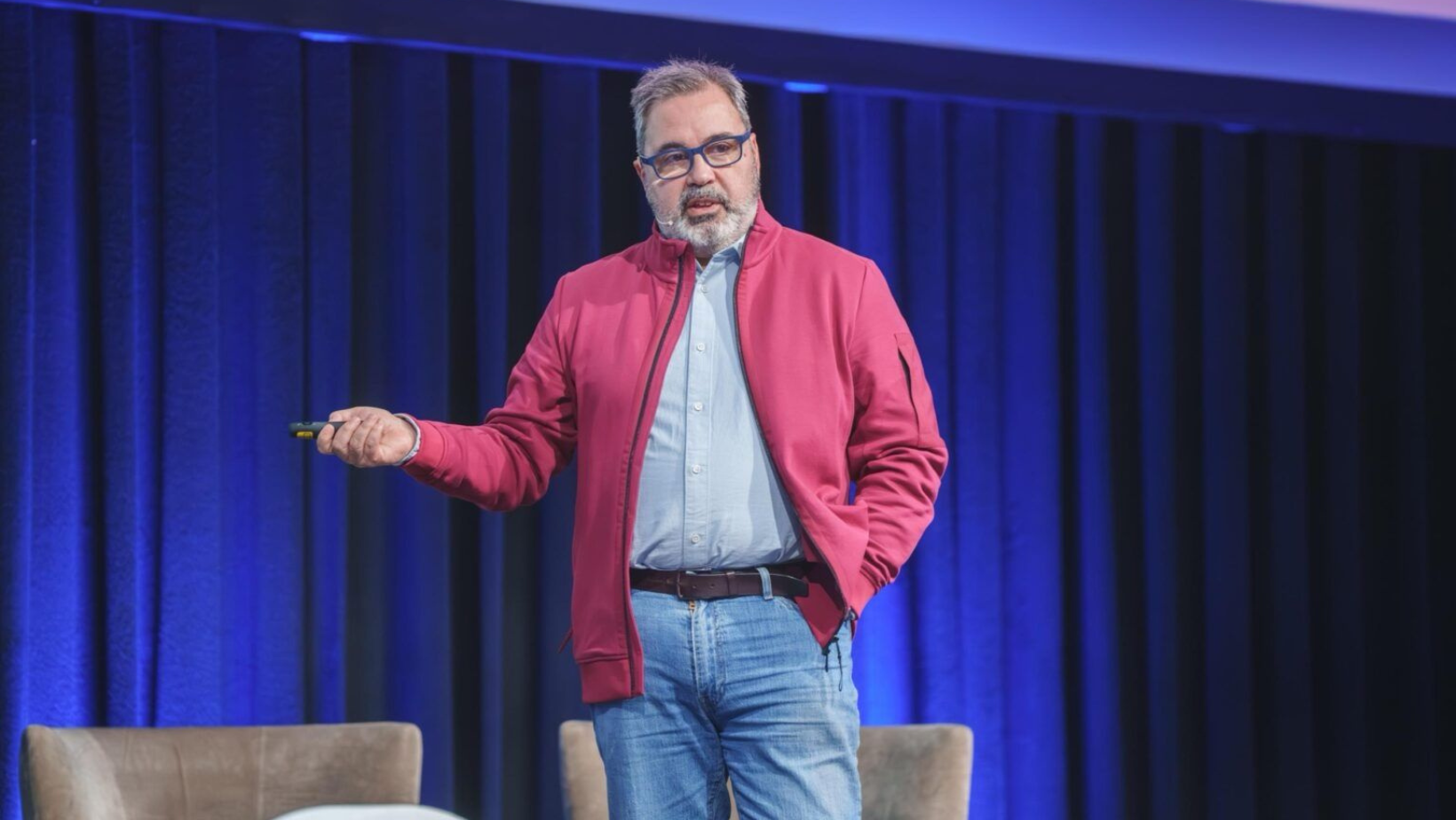
Gianluca Fiorelli is a Strategic and International SEO and AI Search Consultant with nearly 20 years of experience, working with global brands across Europe, the US and international markets. A former Global Associate at Moz, he is a Global, EU, US and UK Search Awards judge and the host of The Search Session, where he explores the evolving search landscape with industry leaders.
When I finally met him in person at the International Search Summit in Barcelona I understood why he is so well liked by other professionals, not just for his work but also as a person.
1. In your 2025 year-end reflection, you spoke about “rediscovering your true skills as a marketer.” What did 2025 reveal to you about yourself?
2025, rather than revealing anything new to me, confirmed something I already deeply believed: that the ideas I’ve been sharing for years—and which some listened to with a certain amount of skepticism—are correct. Namely, that everything that can be summarized as “semantic SEO” is essential to ensuring a website (i.e., the digital representation of a company) is fully understood by “machines,” and that SEOs are the best professionals to perform this work of interpreting and translating between Brand and Machine.
On a more personal level, and perhaps precisely because of the confirmation I mentioned earlier, I’ve learned to procrastinate less and to be more reactive and quicker in putting my ideas and experiences down so I can share them with everyone. In other words, I’ve (re)learned that if I want to be among the “singing voices,” I can’t hope to be so if I don’t write, speak in public, comment on what others share, engage in dialogue… in short, if I don’t put myself front and center.
2. As the director and host of The Search Session created in collaboration with Advanced Web Ranking, what types of conversations did you feel were missing in the industry?
The Search Session isn’t an idea born overnight; The Search Session is the heir to the spirit of The Inbounder, the SEO and Digital Marketing conference I created and directed between 2015 and 2018, which can be summed up with the tagline “Straight to the Future.” That is, it’s a space where, while discussing the present, we try to anticipate future prospects starting from the present, but to do so in a practical and actionable way.
In other words, what to do today for the future that is hurtling toward us like a runaway train, and thus be prepared and ride that future successfully… and better than those who endure it and try to resist with purely reactive actions.
This is what I’ve always felt was missing from a flood of articles, decks, and videos always exclusively about the present (“how to implement hreflangs,” “how to write emails for successful outreach,” “the ten mistakes to avoid when optimizing website performance”).
Not that we shouldn’t also discuss highly practical and current issues, but I believe it’s also possible to discuss future scenarios (closer than generally believed) in a way that’s not just theoretical but also highly practical and actionable.
The Inbounder first and The Search Session now seek to offer a space for that kind of discussion.
3. After speaking at international events such as International Search Summit, SERP Conf, and WMF, do you see a real gap between what is discussed on stage and what companies actually apply day to day?
What I see is still a certain degree of confusion among companies. On the one hand, there’s awareness and evidence that people’s search behavior is radically changing; on the other, it’s also clear that, although LLMs have become a force in the search journey (and the customer journey), they don’t generate the traffic that companies might have expected.
Furthermore, this confusion is largely due to the lack of a real and effective method for measuring the impact of a brand’s visibility in summary responses.
Finally, there’s the issue of how to distribute the budget. Previously, it was “simple” because it was just classic SEO and essentially just Google; now, however, that same budget must be distributed across multiple fronts, and often, there’s no reliable data to justify one investment or another, leading to sometimes erroneous decisions.
At conferences, the best presentations are those that present ideas on how to address this uncertainty realistically, practically, effectively, and, most importantly, without throwing away years of good SEO practices that not only underpin a website’s organic success but also—as has now been more than proven—are essential for success in AI Search.
4. With search changing so rapidly, many SEO and PPC professionals feel both excited and exhausted. What advice would you give to stay relevant, motivated, and strategically solid over the next few years?
My suggestion is to put yourself in the student’s shoes: read, study primary sources of information (perhaps with the help of AI itself, such as NotebookLM, when the source is as complex as a patent), experiment (it’s never been easier to do so), test, and “break things.”
Then, don’t just learn how AI Search works, but expand your knowledge to less technical areas, closer to pure marketing. For example, there’s a lot of talk about brands, but how many SEOs and search professionals have a real understanding of what a brand is?
And share everything, join conversations, share your ideas, dare to admit mistakes, and start over.
But also don’t make the foolish mistake of forgetting everything from the past in the name of “GEO.”
As I said before, SEOs (and search marketing experts in general) are probably the most suitable professionals to help companies in this transition from traditional to agentic search.
5. A significant part of your current work focuses on ontologies, taxonomies, and knowledge architecture. For professionals coming from a more traditional SEO background, why is this approach more important than ever today?
First, I need to explain why I’m so interested in these topics. It’s essentially due to my studies. In fact, literally in the last century, I studied linguistics, semiotics (with Umberto Eco), philology (with Cesare Segre), philosophy of language, and even library science at university—those disciplines that study how people convey meaning and understand the meaning of what they say/hear, write/read, and represent with images/see.
This knowledge, since the advent of Schema.org and the Knowledge Graph, and then with the ever-increasing use of machine learning and natural language, and image recognition algorithms, has underpinned the evolution of search.
Because, ultimately, all search and answer engines have the mission of offering the best answers and the best sources for those answers to their users, and to achieve this goal, they must be able to understand the meaning of the written, visual, and audio content shared online.
Of course, there are other elements, such as technical ones or those related to the authority of the source, but the ability of the content to be understood is the foundation without which everything else is of little effect.
Hence, my interest in ontologies, taxonomies, semantics, and the context in which content is presented, and in how those classic principles of linguistics are translated so that they can be applied by machines.
6. Despite how much search has evolved, many companies remain obsessed with keywords and rankings. Which metrics do you believe will matter most in 2026 for a real, sustainable business?
I don’t have a definitive answer, but I tend to focus on these:
1) The level of visibility of a brand in relation to a topic. For example, a company may have high visibility for one topic but not for others that are essential to its business.
2) The quality of a brand’s visibility for itself, i.e., what AI models know about a brand and, therefore, tell us about it. In some ways, it’s Online Reputation Management, but from an AI perspective.
3) Volume of branded queries (brand + keywords, where the brand can also be the name of a product, not just the name of the company that produces and/or distributes the product).
4) Average search volume for the brand name.
5) Share of voice, i.e., the frequency and quality of mentions of a brand as such and in relation to the products/services it offers.
6) More difficult, but not impossible, to measure is the contribution of organic visibility to conversions generated by other channels, because a person during the search/customer journey is essentially like a ball in a pinball machine: it bounces from one surface to another.
7. As search expands beyond Google into conversational AI, agents and generated answers, how should brands think about visibility across the entire customer and search journey?
Companies should consider visibility in summary responses as a positive branding and reputational opportunity.
Studies are showing that people, despite all the criticisms, including valid ones, about the hallucinations that AI models still suffer from, tend to consider responses from ChatGPT, Perplexity, Gemini, and AI Overviews/Mode as reliable (and in the vast majority of cases, they are). Therefore, being mentioned as a source or solution can have a strong positive impact on people’s memory and, therefore, generate further searches (including other platforms) and, ultimately, visits and conversions.
If, as sometimes happens with AIO and AI Mode, the mention is an actual citation, that is, a blue link in the response itself, other studies—and I’ve verified this for some clients—present CTR data similar to that of a featured snippet: 30%/35%.
On the other hand, if visibility in summary responses is neglected, companies could find themselves with reputational problems and negative visibility (and memorability).
8. When it comes to “optimizing for AI,” what strategic mistakes do you see brands making most often today?
The biggest strategic mistake is to rely on so-called GEO gurus and completely abandon good SEO practices in the name of revolutionary visibility in AI models.
On a more practical level, the most common mistake is to radically update existing content that already has excellent traditional SEO visibility, and most likely even in AI models, to optimize it for AI Search… and thus destroy the foundations of the visibility you already had.
AI Search optimization work must always be “defensive,” meaning how to improve visibility in AI models without losing the visibility already gained through years of SEO.
9. What role do you think personal branding and individual authority (expertise, authorship and reputation) will play in the future of SEO?
Its value was already significant before the advent of agentic search, but it has certainly made it even more relevant.
If we look at it from the perspective of semantics and entity search, a company’s value lies not only in the simultaneously physical and abstract entity of the “company,” but also in the relationship it has with the people who work there, who collaborate with the company, and with the companies and people with whom the company works or offers services.
This means that a company’s value is also built thanks to:
1) The value of the people who work there (for example, the CEO, but also their engineers and product/marketing directors) and, therefore, how much the “machines” know about those people.
2) The value of the people who collaborate with the company, for example, the creators who talk about it, create content for it, and so on.
3) The value of the companies with which they collaborate or to which they offer services; hence, the importance of case studies or co-marketing efforts.
If you think about it, what I’ve described from the entity search perspective is nothing more than pure and simple marketing, and how we—the people—value one brand over another.
10. Could you give us a preview of what you’ll be sharing at SEOFOMO Berlin or at Friends of Search in Amsterdam?
I honestly don’t know what I’ll share at SEOFOMO Berlin. SEOFOMO, being a meetup, could be compared to a jazz concert, where each panelist improvises their part to a piece played alongside other musicians.
For Friends of Search, I’ll present an updated and improved version of my workflow for creating topical hubs that can help build a brand’s authority on a specific topic and, therefore, be considered a source of truth for that topic.