
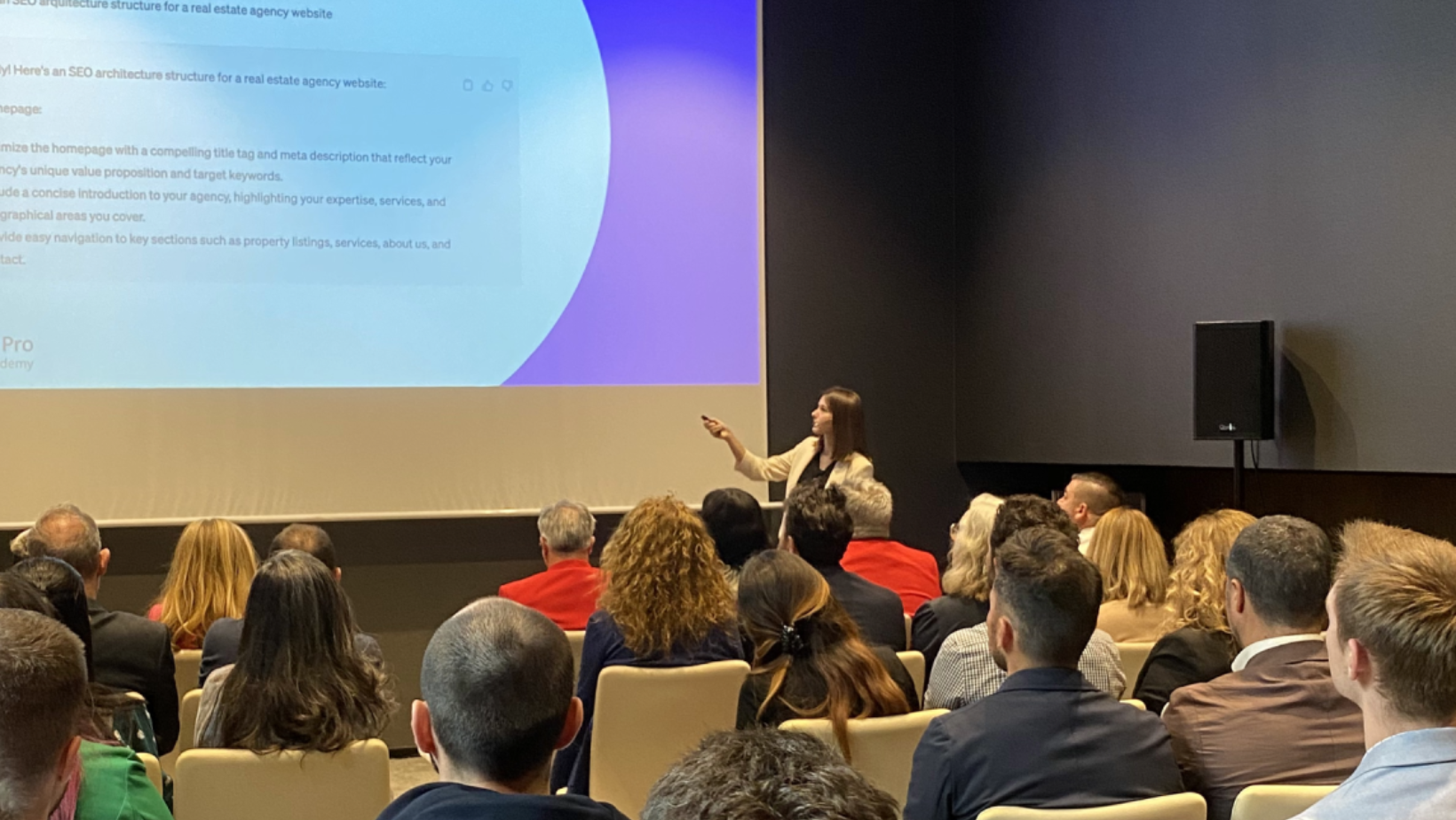
Daria Miroshnichenko is an SEO Manager with over seven years of experience growing websites through data driven organic strategies. She currently works at Adevinta, leading SEO initiatives for large scale platforms and collaborating closely with product, content and engineering teams.
She specialises in agile SEO, technical optimisation and building long term growth strategies. She is one of those quiet, low profile professionals who turn out to be a real hidden gem.
1. When did you start working in SEO and what do you like the most about it?
I started working in SEO more than seven years ago. I began with an internship in a marketing department, where I had the chance to try a bit of everything: SEO, paid media, SMM, content, and digital PR.
At the time, I had just moved to Spain, and I realized that, on the one hand, I needed a skill I could use in any country if I ever moved again, and on the other hand, it had to be engaging enough that I wouldn’t get bored after a few years.
I was immediately drawn to SEO. It felt like a field where you constantly need to learn and adapt to keep up, which sounded like a lot of fun to me. I’ve never regretted that choice 🙂
2. Looking back at your experience, what’s one SEO belief you’ve had to unlearn over the years?
I think the most important thing I had to unlearn was the belief that SEO is unmeasurable. It’s true that results don’t always come immediately, and unfortunately, we can never guarantee outcomes that depend on Google updates or broader industry events. However, it is possible to create forecasts, run A/B tests, and use a wide range of metrics and OKRs to evaluate whether actions are working or not.
At the same time, I also had to accept the opposite reality: there are things I simply can’t influence, and SEO comes with a high level of risk and ambiguity. Just because a strategy delivered results for one website within three months doesn’t mean the same approach will work just as well (or just as quickly) for another.
3. You’ve worked on everything from local SEO to large-scale marketplaces. What fundamentals stay the same regardless of size?
I believe the first step for any website – big or small – is to clearly understand its current situation and identify what is working well and what is not.
The key to a successful strategy is understanding the core reason why SEO is underperforming (or not performing as well as we’d like). For me, the main foundation of any SEO strategy, regardless of website size, is accurately identifying the main issue and the weakest point. For small or new websites, this is often a lack of authority. For larger websites, it may be crawl budget limitations or technical health issues.
I believe the core SEO elements are largely the same everywhere, but the most important fundamental is knowing how to prioritize them in a way that drives real impact.
4. pSEO often looks simple from the outside. What’s the part of programmatic SEO that tends to be underestimated the most?
I believe the most overlooked part of pSEO is post-launch iteration. I’ve seen many projects where thousands of pSEO pages were launched at scale, and a year later only 10–15% of them were generating any SEO traffic. The rest of the pages simply existed to waste crawl budget without bringing visits or leads.
That’s why I believe it’s crucial to remember that launching pSEO pages is only the beginning of the project. The real work starts afterward, when you evaluate the results, unpublish irrelevant pages, and create new ones to be tested, validated, and either kept or eliminated over time.
5. How do you balance research, experimentation, and real-world constraints when building long-term SEO strategies?
I love the product-led SEO approach. I always start by collecting data and identifying problems and opportunities. Once that is done, I define a strategy with a list of actions prioritized by potential impact.
Then comes the experimentation phase. I usually start implementation with MVPs and projects that are easy to launch. Once they are live, I look at what is working, what is not, and why. At this stage, I try to identify real-world constraints and problems in order to iterate on the initial proposal and understand which hypotheses are viable for the sector and which ones should be discarded.
6. With AI accelerating SEO workflows, how do you decide what to automate and what to protect from automation?
In my case, I try to automate any repetitive actions that do not add value in terms of understanding the project better or drawing meaningful insights.
For example, I would never automate keyword research, even though it can take many hours. Doing it manually helps me better understand the sector and the business, and allows me to see connections between concepts.
On the other hand, I am happy to automate benchmarking when I need to analyze dozens of websites. Tools like Claude can summarize HTML elements across pages in seconds, and often do a better job than I could in hours.
So my approach is to automate manual, low-quality work, but not tasks where human thinking and context are essential.
7. What signals tell you early on that an SEO strategy is actually working (or heading in the wrong direction)?
The first signal I look at is the Sistrix Visibility Index. Even though I would never use it as an official KPI, for me it is the first indicator that the SEO strategy is moving in the right direction.
The next, and more important, indicator is SEO clicks to the pages and categories that were optimized. If after three to six months there is no movement in this metric at any scale, something is not working properly and needs to be iterated.
And last, but not least, is the number of leads. It is essential to make sure that the incoming traffic actually works for the business and is not just a vanity metric.
8. After working with millions of URLs, how does your way of thinking about SEO fundamentally change compared to page-by-page optimization?
I think that when I started working with websites that had millions of URLs, I stopped paying attention to micro-optimizations and began focusing on the bigger picture.
When I worked only with small websites, I tried to fix every single issue such as 404 errors, redirects, canonical tags, and so on. Once I moved to larger websites, I started seeing patterns instead of individual errors, and problems at a much larger scale. When a website has 10 million URLs, twenty 301 redirects no longer really matter. Systematic issues, on the other hand, such as all deactivated pages automatically redirecting to the homepage, start to play a much bigger role.
For me, this was a shift in mindset. I began focusing on underlying problems rather than individual errors.
9. You make a strong distinction between SEO maintenance and SEO strategy. How would you explain that difference to a company that’s still stuck in checklist mode?
For me, the main difference is that in many cases SEO checklists lead to blind optimizations that do not take into account company KPIs, OKRs, or broader business objectives. They usually help cover the SEO basics, but very quickly hit a ceiling and stop bringing additional traffic or meaningful results.
An SEO strategy, on the other hand, is connected to the overall product or marketing strategy. It adapts to business goals, addresses current weak points, and takes into account market trends, competitors, and other relevant factors. This is what allows SEO to become a real business lever, rather than a siloed set of micro-optimizations that can be done once and forgotten.
10. What advice would you give to someone who wants to work in SEO in a country other than their own?
I believe SEO is a great career choice for anyone who wants to move countries. So honestly, my advice would be to just go for it and never stop learning. Talk to people, watch videos, read books, and follow SEO influencers on LinkedIn. SEO is extremely fun and very expat-friendly!