
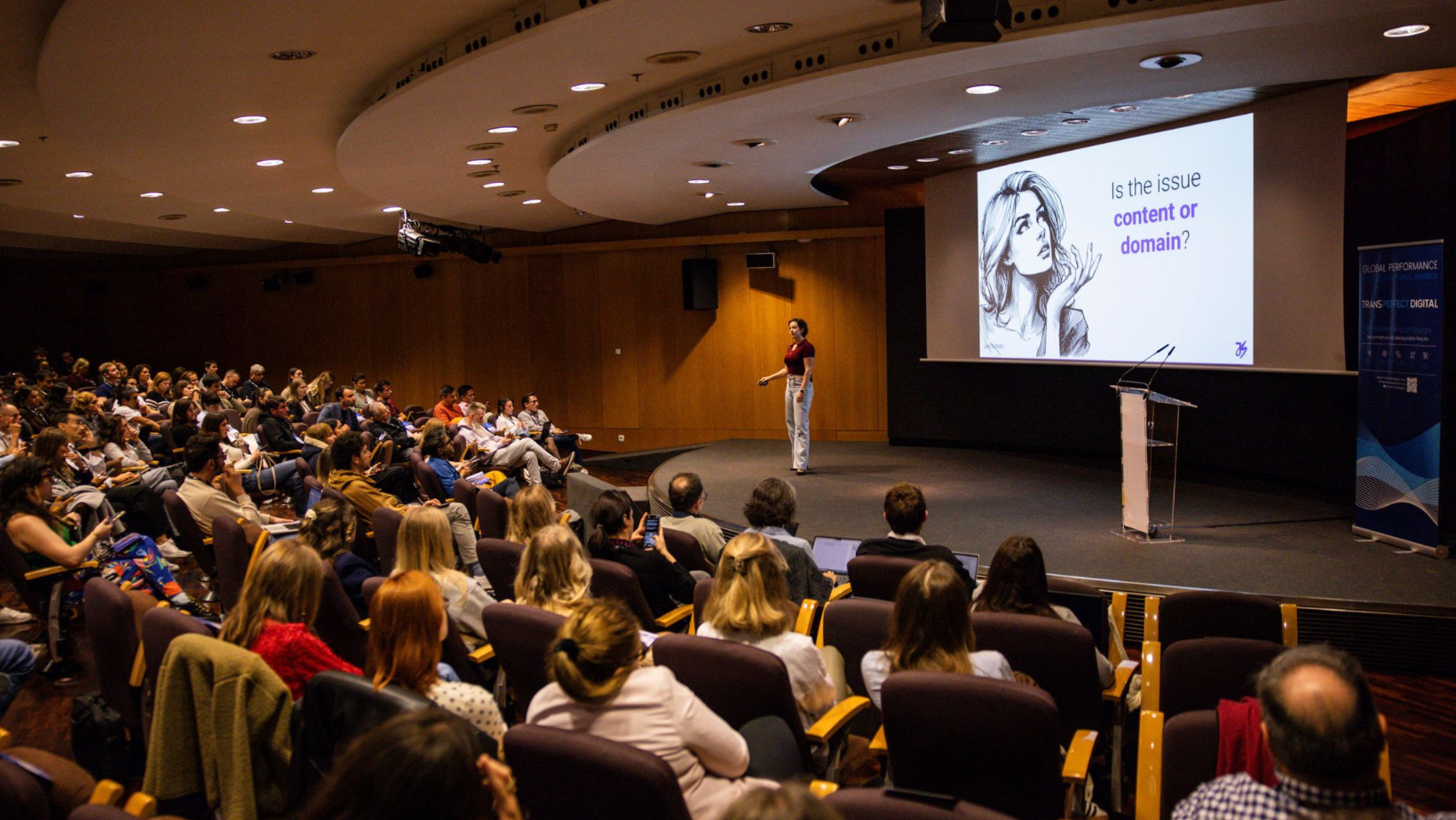
Jes Scholz is a growth marketing consultant and SEO futurist, specialising in audience development, digital brand management and smart content distribution. Based in Australia, she works with enterprise brands globally and regularly speaks at leading international conferences. Jes is also a judge for the APAC Search Awards and Friends of Search Awards and a contributor to Search Engine Journal, Search Engine Land, Moz and OnCrawl.
I was truly impressed by her strength and the way she owns the stage as a speaker!
1. The term “SEO Futurist” is central to your positioning. What does it actually mean in practice today?
I see SEO as an ever-evolving ecosystem shaped by technology, platforms and behaviour. Tactics that have been previously proven are necessary foundations, but as everyone knows them, they are unlikely to offer a competitive edge. I look towards where attention, discovery and decision-making are moving. This takes belief and discipline as it’s often before the metrics catch up.
That being said, one must anchor any future looking marketing strategy to principles of how brands are retrieved and recommended by both machines and humans. The goal is always resilience. To keep my clients’ brands relevantly visible, even as selection systems, interfaces and formats change.
2. AI has made many traditional SEO tactics feel uncomfortable or outdated. Why is this discomfort a healthy correction for the industry?
SEO often suffers from self referral. Enough say tactic X works, so many people follow and then the tactic’s commonality ensures it stays in the mainstream with no legitimate case studies to prove it works. A recent, yet relatively harmless example is, LLM.txt.
More dangerous examples are large scale link building based on “DA”, rather than limiting to topically relevant sites in good digital neighbourhoods. Chasing position 1 rankings, when personalisation has been in place for over a decade. Pushing thin content into the index for indexing sake.
All of these were seen as SEO successes. They moved vanity metrics. But they were based on exploiting a gameable system. And then AI came and changed the rules. Now many historical SEO tactics have no impact or worse negative consequences.
The reality is, our industry became exceptionally good at optimising for things that weren’t worth optimising for in the first place, as they didn’t grow the brand. So a lot of past work now feels hollow.
Impactful SEO requires a shift from manipulating signals to building memory structures for humans, algorithms and AI systems.
This requires a deeper understanding of marketing than many SEOs have been asked to practise before. One that values building brand salience over hacks and shortcuts.
The industry is growing up.
3. A recurring theme in your work is the shift from rankings to memory and brand salience. What mindset change does this require from marketers?
It requires accepting that meaningful KPIs can not be tracked on a daily basis. Market share is measured, at best, quarterly. More often biannually. Impacting it requires a well-thought out strategy executed with conviction. It demands discipline, diligence, and the consistent use of distinctive brand assets. This kind of longevity has historically been undervalued in the digital space, yet it is precisely what marketing science shows to be effective.
4. Distribution is something you prioritise over simple publication. What does effective content distribution look like heading into 2026?
Effective content distribution requires smart automation to maintain a strong presence across all relevant channels. Not only Google, but all search, discovery, and entertainment surfaces.
The challenge is, most teams fail on efficiency or effectiveness.
Either manually curating, crafting and publishing for every channel. And failing due to time constraints.
Or automating posting with no selection logic or oversight. And failing due to poor engagement.
There is a sweet spot middle ground. Focus 60% of your energy on creating and keeping up to date distribution worthy content that boost brand salience. Another 20% into strengthening the system that can serve all these interfaces – tweaking selection logic, fine tuning AI and integrating APIs to remix it. Keep 20% in reserve to respond to whatever is happening in the market. Then scaling becomes straightforward.
Distribution worthy content is like water, it can take many forms, flow into many different containers, be mixed with other elements in order to sustain many different audiences.
5. Visual drawings are a distinctive part of your talks and help clarify complex ideas. Are these illustrations created by you, and what tools or process are behind them?
I always wanted to be able to draw beautiful things. For years in high school I tried my hand at it. But since Uni hit, I never had time to invest in it.
So I am grateful we now have generative AI as it allows me to create the imagery that lives in my head. My preference is a DALL-E and Nano Banana combination. Backed by a prompt I’ve tweaked over the years and the Gemini Gem’s history.
6. After speaking at conferences around the world, what elements consistently separate a memorable talk from a forgettable one?
Delivering new insights is table stakes. That matters. Read it again. Sharing interesting information alone is not enough to make a talk memorable.
You must add showmanship. A hook, a story, a flow, an energy. A style of presenting that is undeniably your own.
Dave Trott once delivered a completely slideless presentation. For 40 minutes, he drew images live under a projector as he spoke. It was phenomenal. And uniquely him.
But always remember, you never have a single minded audience. What is mind blowing for one person may be mundane for another. Accept upfront that it’s impossible to please everyone.
7. Your stage presence is incredibly strong and confident. Which techniques help speakers truly own the room, especially when they’re just starting out?
My advice for new speakers (especially female ones) is practice within your own company first.
I worked in-house for over a decade. As soon as someone loads up 10 bullet points with a chart on the side and starts reading the slide, you feel the whole room disconnect.
So when I was the presenter, I refused to use the corporate slide deck template. Because I needed that room to listen to what I had to say. I stopped having a difference in style between internal presentations for work projects and the external ones you now see on stage. It was in those internal meetings I created my style. And frankly that was one reason I rose to become a CMO before the age of 30. Because I made the executives listen.
To craft your own style as any actor, dancer or other creative does. Study the work of people you admire. Watch videos of your favourite speakers as well as famous speakers from all different industries. What elements engage you? Find inspiration. Adapt it to be your own.
And when you get that breakout opportunity, many SEO conferences offer speaker coaching. Take advantage of this.
If they don’t, make your deck a few months in advance and present it to your colleagues, friends, family, people you just met at the park, anyone who will listen. Incorporate their constructive criticism. And once you think it’s good enough, record yourself presenting it like you are on stage, and critique yourself. There will be more edits. And that is a good thing.
8. Judging major international search awards offers a unique perspective. What do the strongest campaigns tend to get right beyond tactics and execution?
They stand out in the way they are written.
The judges are inundated with briefs and, speaking for myself, I’ll read many in a single sitting.
Those that can concisely explain the 5Ws tied to measurable change in a real marketing KPI (not an SEO metric – there is a big difference!) win it every time for me.
This can be done rather easily, I see strong contenders often use frameworks, like SMART goals, when filling in their applications.
9. What excites you most about the future of SEO and growth marketing?
What excites me most is that SEO is finally escaping the monotony of a Google focussed tactics checklist.
We are moving from ranking pages to being retrieved, cited and acted on by many different algorithms. That forces a return to first principles. Brand salience. Digital availability. Market share.
That rewards marketers who think in strategic systems, not in SEO hacks. SEO is becoming harder to fake and easier to get right if you understand how brands grow.
10. What do you enjoy most about living in Sydney?
After over a decade in Berlin greyness, having the blue sky and sun greet me most mornings uplifts my mood. I just wish Sydney wasn’t so far away from everywhere else as now I must also spend many mornings waking up in the clouds flying to some other continent.