
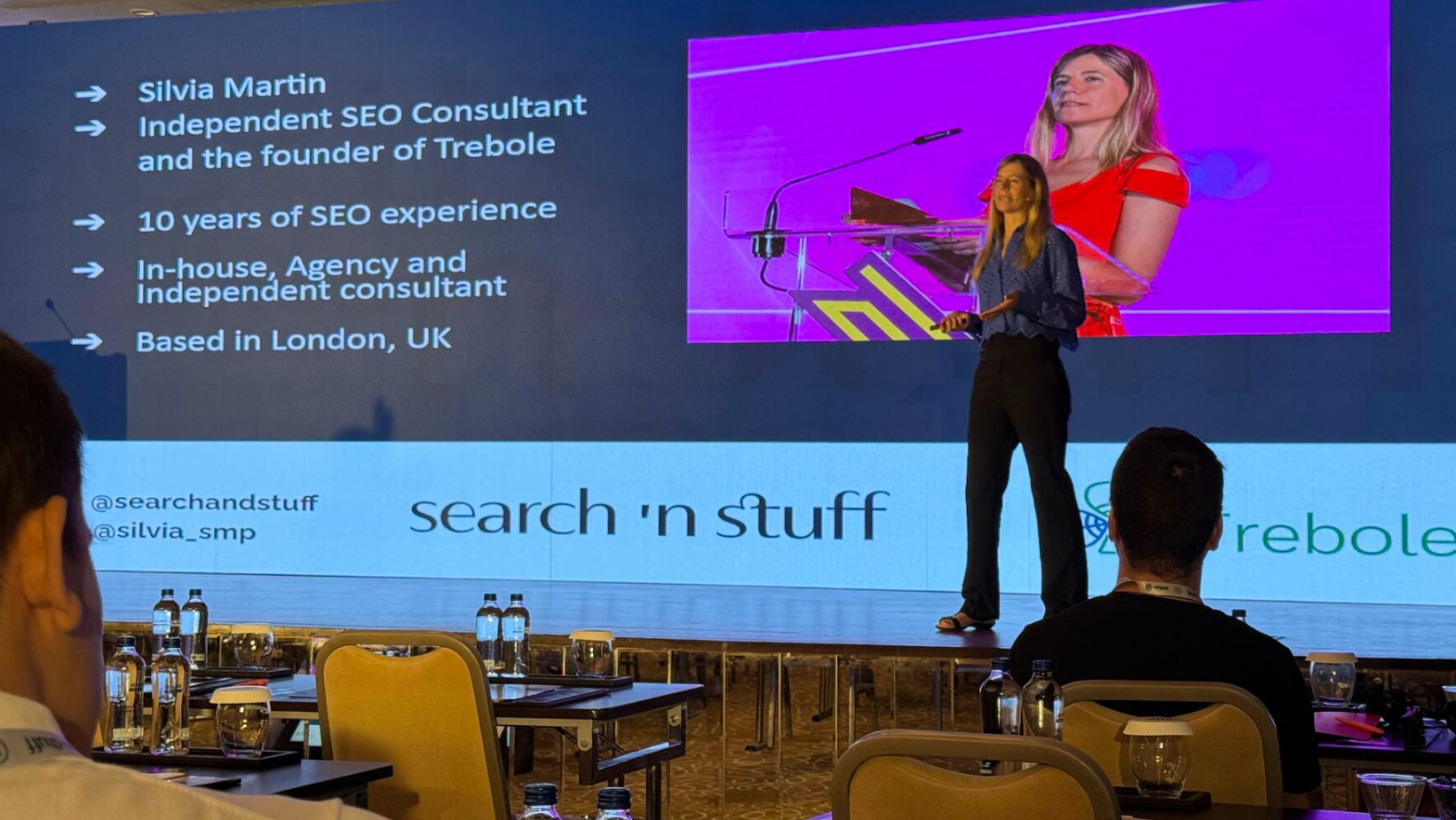
Silvia Martin is an independent SEO consultant and founder of Trebole, specialising in international SEO and long-term organic growth. Based in London, she helps brands build sustainable visibility, authority, and trust by aligning SEO strategy, technical SEO, and content.
I’ve had the chance to listen to her on a Mujeres en SEO podcast and her experience in international SEO is genuinely inspiring.
1. As an independent SEO consultant and founder of Trebole, what type of projects excite you the most right now?
The projects that excite me most are the ones where we build long-term visibility and authority, not just short-term wins, and where SEO is clearly connected to brand, trust, and future-proof growth.
I love collaborating with brands that are already creating content with SEO in mind, but need strategy and technical SEO expertise to unlock their full visibility and make sure their efforts really pay off.
I also really enjoy working on international SEO projects, because this is where strategy, technology, and business goals meet. When a brand operates in several markets, it’s not just about translating content. It’s about structuring the site properly, getting hreflang right, avoiding duplication issues, and making sure each market can actually compete and grow on its own.
2. Working with international brands brings a lot of variety. What challenges come up most often across different markets?
The most common challenges are content duplication, pages ranking in the wrong market, and poor localisation. Many international sites struggle because their content is either too similar across countries or not clearly targeted, so Google does not always understand which version should rank where.
Another big issue appears when brands want to enter a new market. They often focus on SEO first, but SEO alone is not enough. You need a real business strategy and the ability to support that market in the local language. Simply translating content rarely works, because it does not match local search behaviour or user expectations.
Finally, many companies try to grow everywhere at the same time. In reality, they need to set priorities by market and focus their efforts. Trying to conquer the whole world at once usually means underperforming everywhere.
3. SEO fundamentals are a big part of your work and training. Which basics do you think are still misunderstood today?
Many people think technical SEO is just about fixing errors. In reality, good technical SEO can help to improve and maximise SEO performance, especially through things like site structure and internal linking.
For example, Google has said many times that internal links help them understand which pages are important and how the site is structured. Yet, on many large sites I audit, the best pages are often buried too deep, or authority is wasted on low-value URLs.
Another big misunderstanding is crawl budget and indexed pages. People still focus too much on publishing more content, when in reality a lot of sites already have too many low-value or duplicate URLs.
4. You recently delivered an SEO masterclass for copywriters. What usually clicks for them when SEO finally makes sense?
What usually clicks is when they realise SEO is not about writing for Google or bots, but about getting better ideas and giving their content more reach and discoverability. They start to see that SEO helps with content ideation and content creation, and that there are many tools and frameworks that can support them in producing content that performs better.
5. With AI reshaping search and content, where do you see SEO and copywriting evolving together rather than competing?
I don’t think SEO and copywriting compete at all. They are allies and they work best together. AI is creating new search funnels and new platforms where people discover information (Google AI Overviews, ChatGPT, Perplexity, and others), but that makes strong content and clear positioning even more important, not less.
Brands still need to own their content and control the story they tell about their products, values, and expertise. SEO helps make that content easy to find, understand, and reuse by search engines and AI systems, while copywriting makes it useful, convincing, and human. In a world where more and more searches end without a click, visibility and influence matter as much as traffic, and that only works when SEO and copywriting move in the same direction.
6. After years in SEO, what skills do you think matter more now than pure technical knowledge?
Technical SEO is still very important, of course, but today it’s not enough on its own. What really makes the difference now are softer skills like adaptability, continuous learning, and communication. Search and AI systems are changing fast, so you need to be comfortable learning all the time and adjusting your strategies. It’s also becoming essential to understand how AI systems work and how content is found, used, and summarised by them, not just by Google.
7. Which Newsletters or professionals do you find most valuable to follow on LinkedIn?
Aleyda is an amazing professional to follow, she is always sharing great resources, news, and also she has the “SEOFOMO” newsletter, that I highly recommend subscribing to, as well as Kevin Indig’s “Growth Memo” newsletter it’s excellent too.
There are lots of great SEOs to follow such as Dawn Anderson, Giacomo Zecchini, Crystal Carter, Andy Chadwick, Mike King, Judith Lewis, Lily Ray, Barry Adams, Gerry White, Natalia Witczyk, John Sehata, Roxana Stingu, Aoife Mc Ilraith, Clara Soteras, Nick Leroy, David Carrasco, MJ Cachon, Hannah Smith… and so many others. For machine learning and AI for marketers, Britney Muller and Lazarina Stoy are both amazing and worth following, as well as checking their communities and AI courses.
8. What originally took you to London, and how has living there shaped your career in SEO?
I’ve always loved travelling and getting to know other cultures. I have a very curious mind, and I’m naturally drawn to diversity. Before settling in England, I lived in different countries such as Spain, Canada, briefly in China, and France. I originally came to London because of the work opportunities, but not only for that, I had always found it a fascinating city, full of diversity, events, and culture.
Living in London has shaped my career in a very strong way because it’s a real talent and knowledge hub. There are many conferences, meetups, and SEO events where you can learn, share ideas, and meet amazing professionals from all over the world.
It also offers great job opportunities and the chance to grow, either by progressing within a company or by changing companies and roles to keep learning. Being in such a competitive and dynamic market pushes you to keep improving, stay curious, and stay up to date, and that has had a big impact on how I work in SEO today.
9. Do you see yourself returning to live in Spain at some point, or does the UK still feel like home?
I would love to go back to Spain at some point in the future. Spain is home, and it will always be very close to my heart. But at the same time, I still feel that location matters a lot for business, and London is an amazing place to live and work.
It’s an international hub, full of opportunities, talent, and energy. I’ve been here for 12 years already, and honestly, I’m still not ready to leave, for both personal and professional reasons.
10. Looking back, what advice would you give to someone considering going freelance in SEO today?
Looking back, my main advice would be: do your research first and be very clear about your “why”. Going freelance is not just a job change, it’s a big mindset shift from being employed to running a business. Talk to other freelancers, ask questions, and get clarity on the real steps you need to take. If you can, try to start as a side project or make sure you have at least 6 months of savings before you jump in, so you have time to get established and find clients without too much pressure.
It’s also very important to tell people that you’re now independent: old clients, colleagues, friends, and peers. Referrals are often the fastest and easiest way to get your first clients. And don’t do it alone: get support from communities and networks, especially those with spaces for freelancers. In my case, being based in the UK, Women in Tech SEO and the Digital Marketing Union (DMU) were incredibly helpful, both when I started and even today, to meet like-minded people and get support.