
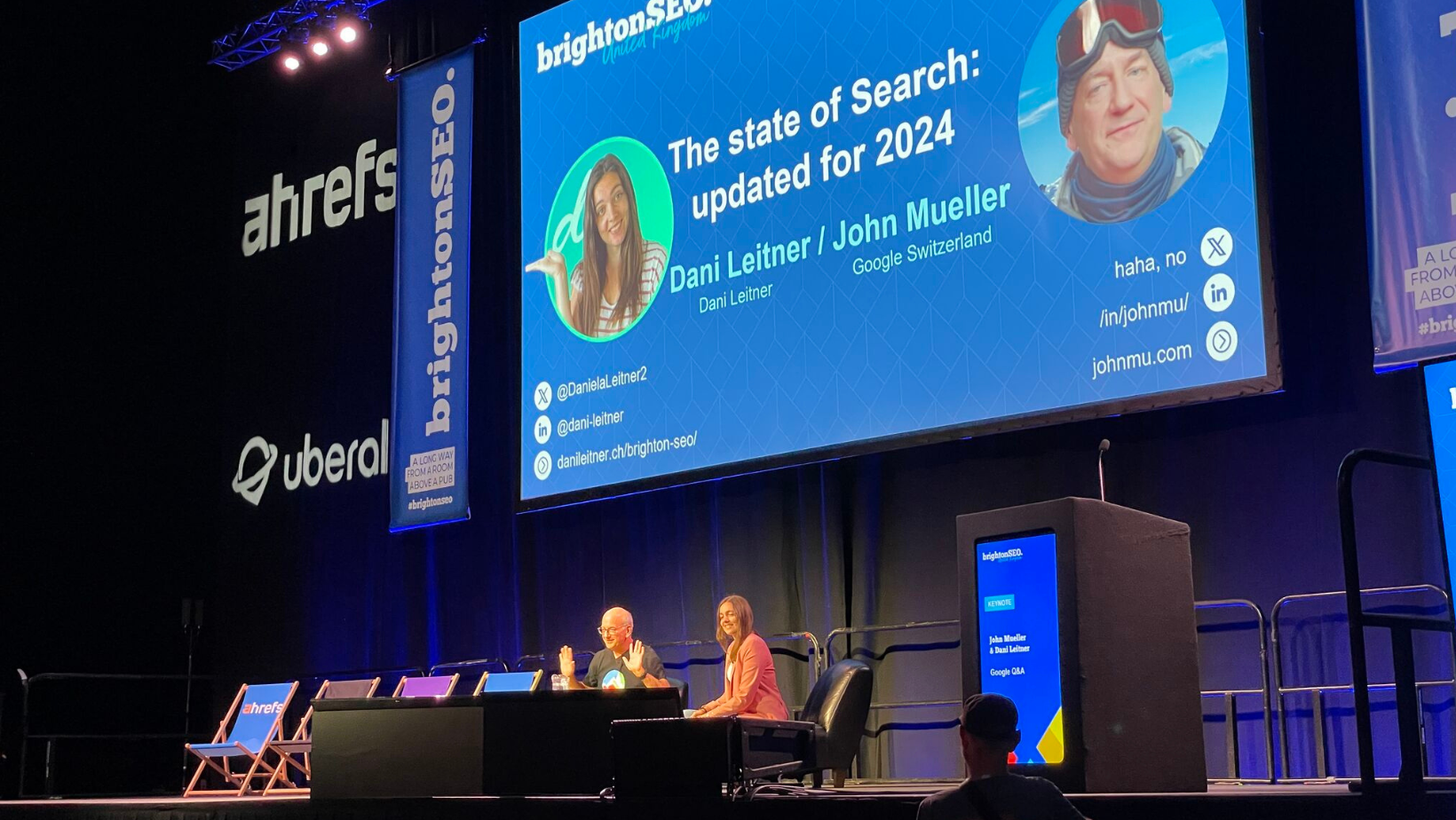
Dani (Daniela) Leitner is an SEO and GEO expert specialising in the DACH market (Switzerland, Germany, and Austria). Based near Zurich, she helps companies generate leads and growth by making their websites visible in Google and AI-driven search.
She’s the most Spanish Austrian I’ve ever met and I strongly recommend subscribing to her podcast: SEO Office Hours en Español.
1. Your messaging is very clear about leads and pipelines, not just traffic. Why do so many businesses still confuse visibility with real business growth?
They actually don’t — at least not at CEO level. If you ask any CEO, they care far more about revenue and cash flow than about traffic numbers.
The real issue is measurement and incentives. SEO performance is still much easier to measure in clicks, impressions and rankings than in actual conversions and revenue. As a result, visibility becomes the proxy metric — not because businesses believe traffic equals growth, but because it’s what most SEO work naturally delivers and what’s easiest to report on.
SEO, as it’s often sold, focuses on blog posts and traffic growth. You publish content, rankings go up, traffic increases — job done. The hard part is somewhere else: convincing a business to rethink its service structure, its positioning, its pricing, and how it presents its offer. That requires strategy, internal alignment and budget — and that’s where real growth happens. Visibility is easy. Building an SEO strategy designed for growth is not.
2. Are most of your current clients based in Switzerland, or do you work more internationally across the DACH region?
At the moment, my clients are based across Switzerland, Germany and Austria.
3. Many of your clients are service-based businesses. What usually makes the biggest difference in turning rankings into actual enquiries?
Service pages.
More specifically: clearly defined services, strong positioning, and a conversion strategy behind the call-to-action. Rankings alone don’t create enquiries — pages that explain what you actually offer, who it’s for, and what happens next do.
4. Switzerland, Germany and Austria are often grouped together. Where do search behaviour and expectations really differ the most?
Switzerland is fundamentally different from Germany and Austria.
You can build an SEO strategy for Germany that often works reasonably well in Austria with small adjustments. Switzerland, however, requires a completely different lens — in terms of language nuance, trust signals, expectations, pricing transparency and even how services are described. Treating Switzerland as “just another DACH market” is one of the biggest SEO mistakes I see.
5. GEO and AI-driven search are becoming a big part of your offering. How should businesses in German-speaking markets start adapting right now?
It depends entirely on where the business currently stands with SEO.
Some companies asking about GEO are still barely visible in traditional search. In those cases, the priority is clear: fix the SEO fundamentals first. The good news is that once you gain visibility in traditional search, you often gain visibility in AI-driven search as well.
Other companies already have a strong organic presence and can afford to dedicate budget to AI visibility and GEO-specific optimisations. The most important step is knowing where you are — and not chasing trends just because they’re new or hyped.
And one thing people often forget: great AI visibility won’t suddenly turn a weak business model into a money-making machine.
6. There are plenty of SEO recommendations that sound smart but don’t translate into growth. How do you decide what’s actually worth implementing?
There’s no universal answer — it always depends on the recommendation and the business.
What I generally prioritise are actions close to conversion: service pages over blog posts, clarity over complexity, and changes that make it easier for users to understand the offer and take the next step.
7. SEO Office Hours en Español has become a great space for the Spanish-speaking SEO community. How did you meet Carlos Sánchez, and how did the idea for this live format come about?
It’s actually a funny story. I met Carlos at BrightonSEO in 2024, right after coming off stage from my keynote with John Mueller. He approached me to ask how I ended up speaking on stage with John.
The first thing I noticed was his T-shirt with Spanish text on it, so I immediately switched to Spanish — which surprised him a bit. We ended up spending the next day together in Brighton, as we both had late flights home.
During that same trip, Mike from the English SEO Office Hours planted the idea in my head: why not run Office Hours in other languages? I talked to Carlos about it, he liked the idea, and we decided to give it a try.
8. What do you enjoy most about Spain, what’s your connection to the country, and what do you enjoy most about living in Switzerland?
I lived in Oviedo for ten months back in 2018, which is where my connection to Spain really started. I always loved the language and the country, but everything changed when I met my partner, who is Spanish.
Now Spain feels as much like home as Austria does. We go back every year, I have family there, and I think and dream in Spanish. My partner’s family often says I’m a Spanish person trapped in an Austrian body.
What I enjoy most about Switzerland is the mentality. Things are efficient, straightforward and well organised. The system generally works with you rather than against you — including when it comes to taxes and administration. That combination is rare in Europe today, and it’s the main reason I am not considering to move back to Spain or Austria, even for family or the incredible food in Spain.
9. Speaking so many languages, which language do you think in… and which one do you dream in?
It depends — my favourite SEO answer.
Context matters. My working day is mostly in German, while my private life with my partner is in Spanish. When I dream about my family, conversations are in German. When the dream involves my partner’s family, it’s in Spanish.
Some topics exist only in Spanish in my head — like politics, investing, sales or copywriting — because that’s how I learned them. I can’t always translate those concepts properly into German, even though it’s my mother tongue.
10. For someone visiting Zurich for the first time, what would you recommend doing in 2–3 days?
First of all: come in summer. Zurich is incredible in summer. Bring your swimsuit — the water is crystal clear and you’ll want to jump in.
Spend one full day walking around Zurich: explore the old town, stroll through Bahnhofstrasse for some high-end window shopping, wander through Münstergasse, and just let the city impress you.
Plan one day trip to Lucerne. Take the train, enjoy the Swiss rail system, experience the mountains, and explore one of the most beautiful cities in the country. Have a Rathaus Güggeli and a seasonal beer at Rathaus Brauerei — it’s worth it.
On your third day, enjoy the lake, the river, or one of the Badi. If you’re a woman, Frauenbad Stadthausquai is my personal favourite..