
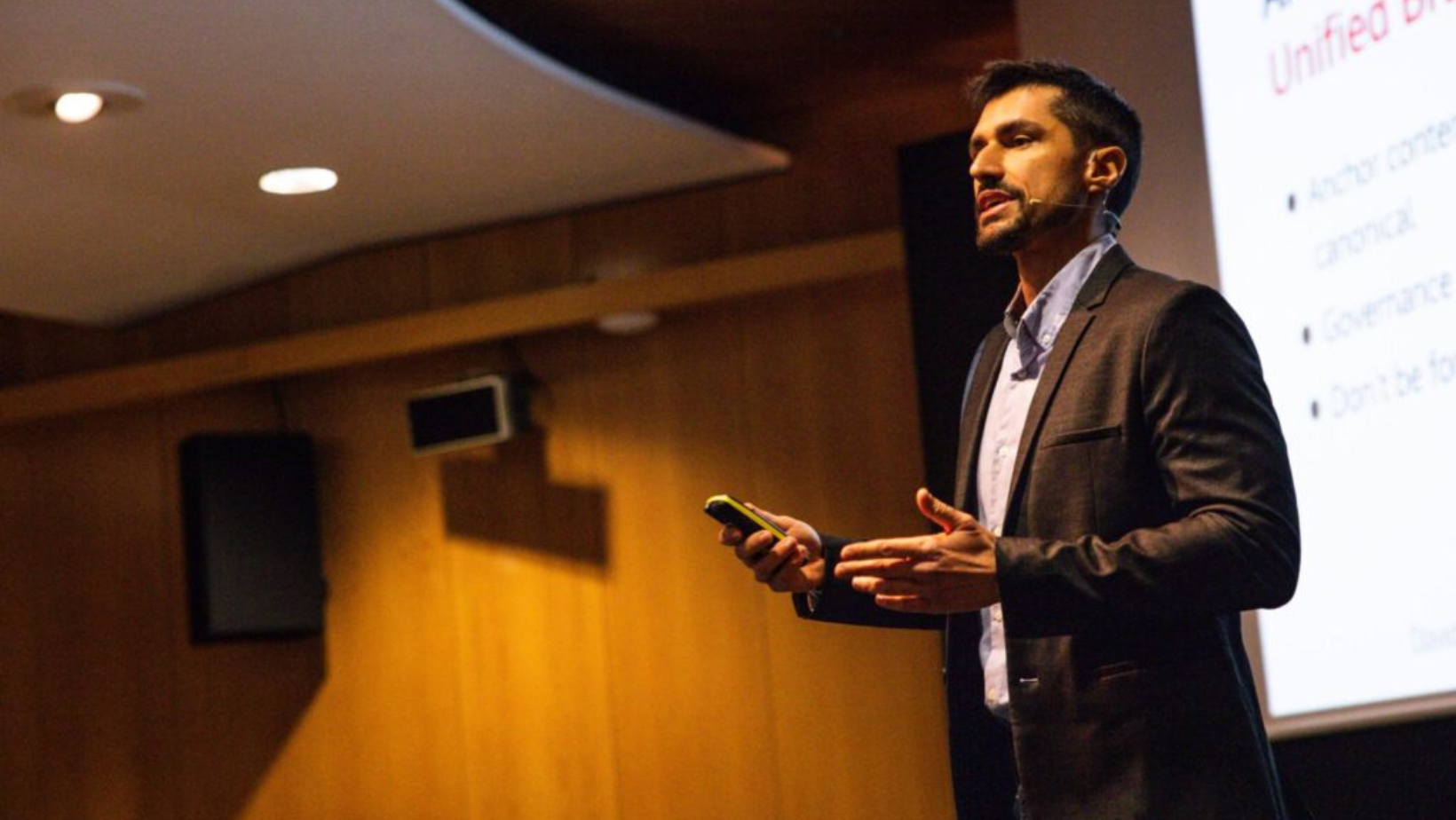
David Carrasco is a Barcelona-based SEO consultant specialising in growth strategies, content, and organic positioning. Beyond his technical expertise, he stands out as one of those professionals who elevate the room both through the clarity of his talks and the thoughtful, constructive advice he offers to other speakers.
Personally, he is one of the people I’ve enjoyed listening to the most at conferences, and it’s an honour that his interview is the first to be published on Global and Search.
1. You strongly advocate for a business-driven, profitability-focused approach to SEO. When speaking with a CEO, how do you translate SEO efforts into metrics that genuinely impact EBITDA?
It always starts with listening. Before talking about keywords, I need to sit down with the client to define their specific stage and objectives. Every project has a different heartbeat.
Once we align on that, I strip away the vanity metrics. We focus purely on economic indicators: qualified leads and revenue. But I also emphasize that attribution is currently broken—no marketing channel exists in a silo. If SEO is working, it lifts Paid Search and improves Social conversion; they feed each other.
Lately, I’ve been pushing the conversation even further towards long-term business health. I talk about LTV (Lifetime Value) and Churn. SEO isn’t just about getting a user to the site; it’s about capturing the ideal audience—the demand that actually connects with the product and stays. That is what truly impacts EBITDA.
2. You often argue that performance-driven SEO and brand-led SEO should work together. When is the right moment for a company to stop focusing solely on demand capture and start generating demand?
From Day One. In today’s market, no project can survive long-term without a soul—without a brand. The distinction between ‘capturing’ and ‘generating’ is becoming artificial.
We need to play on both sides of the field simultaneously. If there are searches across the funnel, there is demand to be captured, sure. But SEO has evolved beyond a keyword-matching discipline. If you only capture existing demand, you are a commodity. If you build a brand while doing SEO, you become a destination. So, the moment to start generating demand is the moment you launch.
3. In many of your audits, you talk about the validation phase and the role of “opinion” searches. Why do you think this final stage is where so many brands end up losing potential customers?
I’ve been having many conversations lately about branding—whether for traditional SEO or the new AI-driven search experiences—and the conclusion is always: ‘There is nothing new here.’ We keep coming back to the basics: Buyer Personas, product quality, and brand consistency. The problem is the gap between knowing the theory and actually executing it.
Think about it: How did you choose a good restaurant before Google? You asked friends (social proof) and you looked for consistency. You needed to know if the experience would match your expectations.
In digital, we’ve spent too many years on autopilot, obsessing over generic, abstract keywords and forgetting the human behavior behind them. SEO doesn’t end when the user lands on your site; that’s just the greeting. We treat our websites like drive-throughs when they should be destinations. We lose sales in that ‘last meter’ because we fail to build the connection, community, and trust required to close the deal.
4. Building a “knowledge universe” for each client using AI is something you often highlight. Why does this approach make such a difference compared to more traditional SEO consultancy models?
This is really just an example of how our sector—and frankly, every sector—is evolving. It’s not about the tool itself; it’s about the shift in efficiency and depth.
Traditional consultancy often relies on generic templates. By using AI to build a specific ‘knowledge brain’ for a client, I can contextualize every strategy against their unique data, history, and voice. It marks the difference between delivering a standardized service and providing a bespoke solution that evolves in real-time. It’s about using new tools to return to the essence of consulting: deep understanding.
5. Weekly analysis of Google and SEO news has become a regular part of your LinkedIn content. With so many updates, AI narratives, and alarmist headlines, which signals truly matter for businesses today?
The signals that deserve real attention aren’t on LinkedIn; they are in your conversations with your customers. That is 80-90% of what any company needs to know.
As for the rest: trust your consultant. My job is to act as a filter. I inform my clients only when there is a structural change that affects their business strategy, allowing us to react before panic sets in. We have regular chats to discuss sector evolution with perspective, away from the daily noise.
If you don’t have a partner you trust, pick one high-quality newsletter, read it for 10 minutes a week, and ignore the rest.
On the innovation side, however, keep one eye open. Don’t just keep up; try to stay ahead. I always advise looking at mature markets like the US or China to spot future trends, while always applying a cultural filter. Not everything that works there works here, but the currents are often the same.
6. You’ve founded and sold a tech company and now work as a strategic consultant. How has being “on the other side” changed the way you advise clients?
I’d love to tell you that I’ve fully mastered the ‘language of business,’ but that’s a continuous work in progress. Our day-to-day is still very SEO-heavy. However, having been a founder gives me a different layer of empathy.
Being on the other side forced me to develop skills often wrongly labeled as ‘soft’: project management, team leadership, finance, and holistic growth. It taught me that a technical recommendation has financial and human implications. It helps me connect with the human reality of the business, not just the algorithmic one.
7. Being named the highest-rated speaker at the last International Search Summit in Barcelona is no small achievement. From your experience, what does a talk need to truly capture and sustain an audience’s attention?
Oh, I’m going to cry. That means a lot.
To be honest, I prefer to answer this from the perspective of a listener rather than a speaker, because that’s where I have the most experience. And the first thing I’ll say is: it is incredibly difficult.
You are fighting against so many factors you can’t control: maybe the topic doesn’t click with someone, maybe they have personal worries on their mind, or maybe they just pull out their phone—which will happen, no matter what. You can do your best, but you can’t control the room 100%.
That said, when preparing a talk, my golden rule is: What is the ONE message or learning I want them to take home? Just one. And build everything from there.
We often make the mistake of stuffing our speeches with too much information out of insecurity. We try to ‘prove’ we know a lot, so we overload the slides. But that just dirties the message. You have to trust yourself and simplify. Choose that one valuable nugget carefully, and stick to it.
Finally, if you want to give talks, my advice is: invest in learning how to do it. I still feel like a beginner (I’m still wearing the ‘L’ plate), but I’ve realized we overlook the basics because nobody taught us. It’s not just about SEO knowledge; it’s about learning how to structure a speech, how to visualize data effectively, how to design slides that breathe, how to craft a strong opening and closing, and how to use storytelling to connect. That’s the real work.
8. Beyond the content itself, how should a strong presentation be structured to truly leave a lasting impression rather than feeling like a succession of slides?
There are many frameworks, but I stick to a classic one tailored to my style:
One core message, three supporting arguments, a strong opening, and a memorable close.
It sounds simple—it’s basically Aristotle—but it works because it respects how the human brain processes information. You don’t need fireworks, you just need clear signposting.
Here are a few specific tricks I use to ensure the message sticks:
• The ‘Cold open’: Never start with ‘Hi, I’m David and this is the agenda.’ That’s boring. Start with a provocative question, a shocking stat, or a personal story. Hook them first; introduce yourself later.
• The rule of three: Our brains are wired to recognize patterns. Whether it’s 3 examples or 3 pillars, grouping your arguments in threes makes them rhythmically satisfying and much easier to remember.
• The circular closing: This is my favorite. Finish the talk by referencing the same story or question you used at the very beginning. It gives the audience a sense of closure and makes the whole presentation feel like a designed journey, not just a random list of slides.
9. If you had to give just one piece of advice to someone building a personal brand in SEO and PPC, what would it be?
Define your map before you start walking.
Clearly decide who you want to be, who you don’t want to be, who you want to reach, and what you want to achieve. Tattoo that on your mind. Your strategy might change, the tactics might pivot, but the map—your core identity—must remain constant. Otherwise, you will get lost in the noise.
10. With so much stimulation, FOMO, and constant information overload in our industry, how do you make space to disconnect and reset mentally?
Honestly? I’m terrible at it. I usually get dragged away by others or forced to stop by burnout—in varying degrees.
It’s not something I have mastered, but the lesson I’m learning is: Listen to yourself. When the body or mind says ‘stop,’ you have to respect it, or it will stop you.